
Step 9 · FDI strategy & topology · 09
FDI Strategy, Topology & Design
D20 — FDI strategy & topology
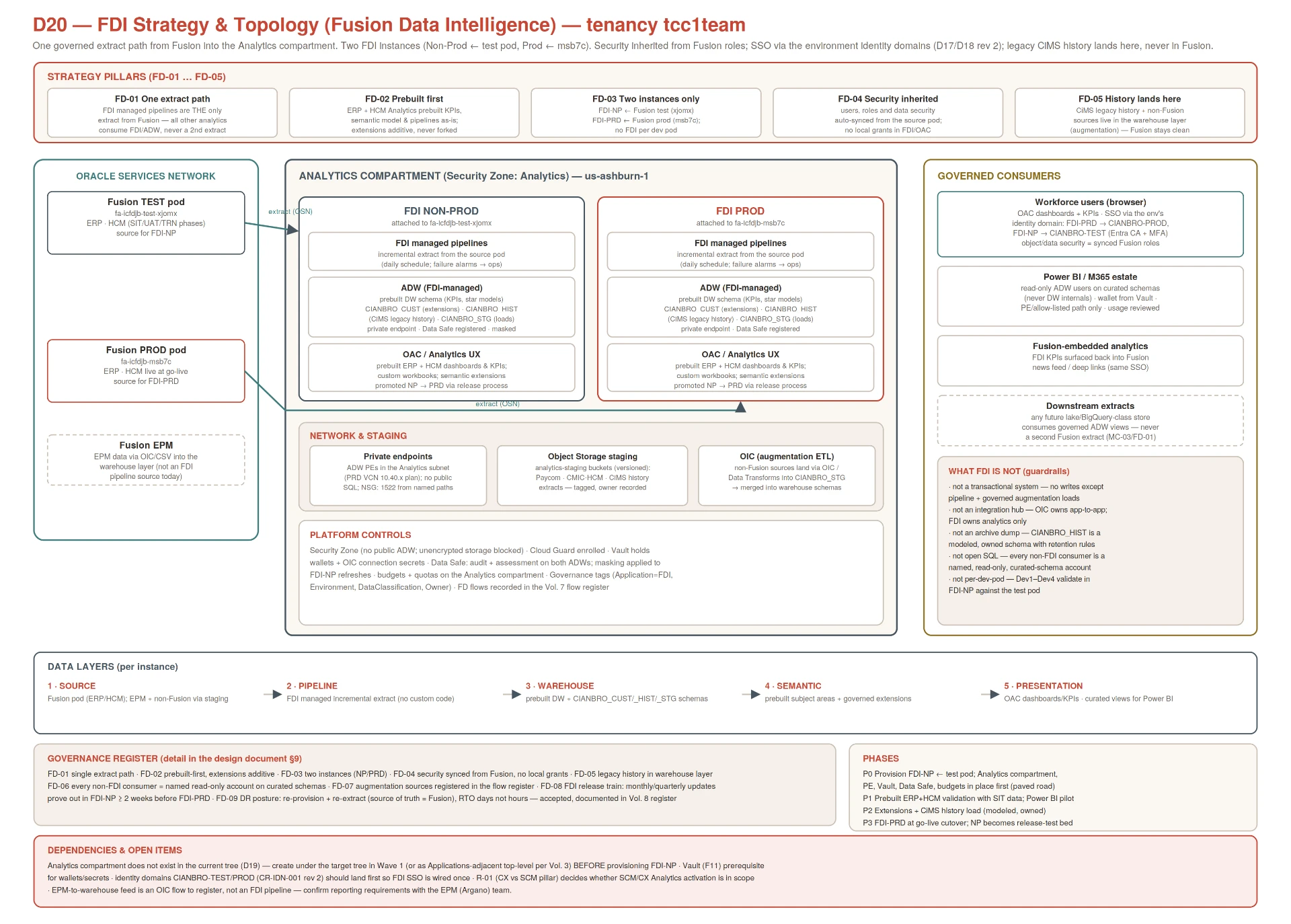
Oracle Fusion Data Intelligence (FDI) is the single governed analytics path for Fusion-derived reporting. This generic v1.0 draft defines strategy, D20 topology, managed ADW and OAC architecture, legacy history, identity, augmentation, releases, operations and FD-01–FD-09 governance.
1. Strategy and governance register
| Rule | Programme standard |
|---|---|
| FD-01 · One extract path | FDI managed pipelines are the only extract from Fusion; other analytics consume governed FDI/ADW outputs. |
| FD-02 · Prebuilt first | Adopt prebuilt pipelines, semantic models, KPIs and dashboards as delivered; extend additively and never fork prebuilt objects. |
| FD-03 · Two instances | Use one non-production instance attached to the Fusion test pod and one production instance attached to the production pod; development validates in non-production. |
| FD-04 · Security inherited | Synchronise users, roles and data security from Fusion; do not duplicate local grants in FDI/OAC. |
| FD-05 · Governed history | Land legacy reporting history in a modeled, owned ADW history schema rather than loading transactional history into Fusion. |
| FD-06 · Curated consumers | Give external SQL and BI consumers named read-only accounts on curated views, with wallets protected and rotated. |
| FD-07 · Registered flows | Register every non-Fusion augmentation source with its owner, schedule, controls and lineage before build. |
| FD-08 · Release train | Validate updates and extension compatibility in FDI-NP for at least two weeks before FDI-PRD; promote with a change record. |
| FD-09 · Recovery posture | Document re-provision and re-extract recovery, protect unique custom/history schemas with exports, and formally accept RTO/RPO. |
2. Target architecture and placement
| Element | FDI-NP · Non-production | FDI-PRD · Production |
|---|---|---|
| Source | Fusion test pod for SIT/UAT/training | Fusion production pod |
| Placement | Dedicated Analytics compartment, private endpoints | Same Analytics area; optional production child compartment |
| Identity | DOM-TEST, Entra SSO, Conditional Access and MFA | DOM-PROD, strict Conditional Access and PIM-eligible admins |
| Sizing | Smallest initial shape; capped auto-scaling | Size from NP evidence; capped scaling and budget alarms |
Dev1–Dev4 validate in FDI-NP rather than receiving individual instances. Create the Analytics compartment and governed subnet placements first; legacy network exceptions are not dependencies.
3. Data and semantic architecture
| Layer | Scope | Guardrail |
|---|---|---|
| Source | Fusion ERP/HCM and other licensed pillars; approved non-Fusion sources via governed staging | Fusion remains the transactional source of truth; analytics never writes back. |
| Pipeline | FDI managed incremental extracts by activated functional area | No custom second extract from Fusion. |
| Warehouse (ADW) | Prebuilt warehouse plus separate staging, custom-extension and modeled-history schemas | Never modify prebuilt schemas; transient staging is not an archive. |
| Semantic (OAC) | Prebuilt subject areas plus governed additive extensions | Promote extensions from non-production to production with a change record. |
| Presentation | Prebuilt and custom OAC workbooks; curated views for external BI | External consumers never receive direct access to warehouse internals. |
Keep DW_STG (transient staging), DW_CUST (extensions) and DW_HIST (modeled legacy history) separate from the unmodified prebuilt warehouse. Load history through versioned Object Storage into staging, conform it to relevant dimensions and expose history plus current reporting through additive semantic extensions. Legacy transactional history does not migrate into Fusion.
4. Identity and security
Use environment-domain Entra SSO, MFA and Conditional Access; synchronise Fusion users, roles and data security without local FDI/OAC grants. Production administrators are a small named PIM-eligible group with no standing administration. External BI/SQL consumers use individual read-only accounts on curated views, private or allow-listed paths and Vault-held rotated wallets.
Apply Analytics Security Zones, encryption, Cloud Guard, Data Safe audit and assessment on both ADWs, refresh masking where required, mandatory governance tags and quarterly certification. HCM makes production Confidential by default; CMMC/FCI-scoped data requires regulated-enclave approval.
5. Augmentation and integration flows
| Flow | Source and path | Target / decision |
|---|---|---|
| FD-F1 | Legacy ERP history → versioned Object Storage → governed load | DW_STG → DW_HIST; owner, retention and lineage |
| FD-F2 | EPM planning/consolidation via OIC or CSV | DW_CUST; confirm reporting requirements first |
| FD-F3 | Payroll feed via OIC or Data Transforms | DW_STG → DW_CUST; versioning, owner and tags |
| FD-F4 | Legacy ERP/HCM feed → governed load | DW_STG → DW_CUST / DW_HIST; agree disposition with conversion team |
Register every augmentation source before build with its owner, schedule and hop-by-hop controls. Use OIC or FDI Data Transforms, not hand-written compute ETL scripts. Other analytics consume curated ADW outputs rather than creating a second Fusion extract.
6. Environments, refresh and release management
FDI-NP receives Oracle updates first, with at least two weeks of prebuilt-content regression and extension compatibility checks before production. Promote extensions and workbooks by export/import with a change record; never rebuild manually in production. After Fusion production-to-test refreshes, re-point or re-extract FDI-NP, reset data, reapply masking and run extension smoke tests. NP remains the permanent release-test bed.
7. Operations, observability and recovery
Monitor pipeline status, refresh lag, ADW utilisation/scaling and OAC availability. The source draft targets business day-1 data by 07:00 ET; confirm this with the customer. Review health and FinOps monthly with budgets, quotas, subscription costs, scaling caps and external BI consumption.
Use ADW automatic backups plus milestone exports of custom/history schemas to Object Storage. FDI is derived from Fusion: recovery is re-provision and re-extract, with RTO measured in days and RPO bounded by the last Fusion state. Record and accept this in the DR register; FDI is not a Full Stack DR member.
8. Phased adoption roadmap
| Phase | Scope | Exit evidence |
|---|---|---|
| P0 · Foundation | Analytics, private endpoints, Vault, Data Safe, budgets and FDI-NP | Paved-road controls live before provisioning |
| P1 · Prebuilt validation | ERP/HCM KPIs, SIT/UAT data, refresh SLO and Power BI pilot | Business KPI sign-off and governed consumer access |
| P2 · Extensions and history | Additive semantics, modeled history and registered feeds | History joins current data; FD-F1–FD-F4 healthy |
| P3 · Production | Provision FDI-PRD, promote, activate at go-live + one refresh cycle | Production refresh green; certification and FD register complete |
9. Dependencies and open decisions
Create Analytics in the Wave-1 target tree, establish DOM-TEST/DOM-PROD federation and Vault before FDI wiring, resolve CX-versus-SCM activation scope and confirm EPM reporting with the partner team.
FDI Strategy, Topology & Design — Word template
Generic v1.0 strategy draft covering D20 topology, FDI, ADW and OAC architecture, identity, augmentation, release management, operations, recovery and FD-01–FD-09 governance. Tailor placeholders and confirm decisions before customer use.
DOCX · 655 KB